Blog
Automating Compliance in the Age of AI
Modern compliance automation helps organizations operationalize AI-ready governance, accelerate audits, and continuously monitor evolving regulatory risk.
Jason Koestenblatt
Senior Manager, Content Marketing
July 10, 2026

As AI adoption accelerates and regulatory complexity grows, organizations need compliance that moves from static to continuous.
Key Takeaways From This Blog
- Compliance automation reduces manual effort and accelerates audit readiness
- AI-ready governance operationalizes oversight continuously rather than periodically
- Framework mapping and control reuse improve efficiency across overlapping regulations
- Continuous monitoring enables organizations to identify risks earlier
- Governance-by-design helps organizations scale AI adoption safely and consistently
What Is Compliance Automation, and Why Does It Matter Now?
Compliance automation helps organizations continuously assess, operationalize, and monitor regulatory and control requirements across frameworks, systems, and business processes. But in today’s environment, automation alone is no longer enough. Organizations must also become AI-ready.
The rapid adoption of AI and agentic systems is reshaping how compliance programs operate. Controls that were once reviewed quarterly are now expected to adapt in real time. Governance can no longer exist as a disconnected process managed through spreadsheets, point-in-time audits, and manual evidence collection. It must become operational infrastructure.
This is where AI-ready governance becomes critical.
AI-ready governance places oversight directly into workflows, systems, and decision-making processes. Combined with compliance automation, it enables organizations to continuously evaluate regulatory exposure, monitor control effectiveness, and scale governance without slowing innovation. The result is a more resilient compliance program that can adapt as regulations, technologies, and risks evolve.
Traditional Compliance Programs Break Down
For years, compliance programs operated on predictable timelines. Organizations scoped frameworks annually, conducted periodic assessments, collected evidence manually, and prepared for audits through concentrated remediation efforts.
That traditional model no longer scales.
Regulatory requirements continue expanding across privacy, cybersecurity, AI governance, and operational resilience. At the same time, AI systems are being deployed faster than most governance structures can evaluate them. Business teams increasingly adopt AI-enabled workflows independently, creating fragmented visibility and inconsistent controls.
The challenge is no longer simply proving compliance; it’s maintaining continuous operational alignment in dynamic environments.
Governance models built primarily around centralized review processes become bottlenecks as AI adoption accelerates. Manual oversight introduces delays, duplicate work, reactive remediation, and audit inefficiencies.
Organizations are reaching an inflection point where compliance must evolve from a periodic function into an always-on system.
From Compliance Management to AI-Ready Governance
AI-ready governance is the operational evolution of traditional governance programs. Instead of relying solely on human review cycles, governance becomes integrated directly into the lifecycle of systems, data, controls, and AI operations.
This shift matters because modern risk environments are constantly signaling.
Generative AI systems introduce non-deterministic outputs. Agentic AI systems increasingly execute actions autonomously. Regulatory obligations evolve rapidly across regions and industries. Static governance models cannot keep pace with systems that continuously change behavior.
AI-ready governance addresses this challenge by embedding oversight into operational workflows.
That means organizations can:
- Automatically classify AI and compliance risks during intake processes
- Continuously monitor controls and evidence collection
- Trigger workflows when anomalies or policy violations occur
- Maintain centralized visibility into frameworks, systems, risks, and remediation
- Operationalize policies as enforceable controls rather than static documentation
This transition reflects a broader movement from “governance by committee” to “governance by design.”
How Compliance Automation Accelerates Regulatory Readiness
Scope New Frameworks Faster
One of the first questions organizations ask when facing new regulations is straightforward: “What are our gaps?”
Compliance automation helps organizations answer that question quickly by mapping existing controls, evidence, and operational processes across multiple frameworks simultaneously.
Modern enterprises rarely operate against a single framework. Instead, they manage overlapping obligations across standards such as:
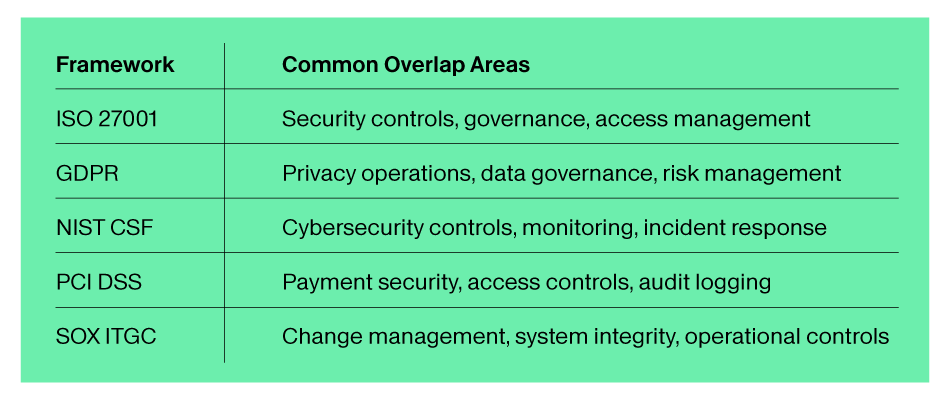
Organizations that already maintain mature programs under frameworks like ISO 27001 often discover significant overlap with other compliance requirements. Compliance automation enables teams to reuse existing controls, evidence, and workflows instead of rebuilding programs from scratch.
This dramatically reduces implementation effort while improving consistency across the enterprise.
Continuously Evaluate Control Effectiveness
Compliance is no longer a point-in-time exercise.
Organizations increasingly need to demonstrate that controls operate effectively on an ongoing basis. Auditors, regulators, customers, and boards expect continuous visibility into compliance posture rather than static snapshots.
Compliance automation supports this by:
- Automating evidence collection
- Tracking control performance continuously
- Monitoring remediation workflows
- Maintaining audit trails
- Standardizing documentation across frameworks
Control effectiveness becomes more than an audit metric. It becomes a strategic operational KPI that helps organizations measure governance maturity over time.
Why AI Changes Compliance Requirements
AI systems introduce governance requirements that traditional compliance models were never designed to manage.
In earlier enterprise software environments, applications behaved predictably. AI systems do not.
Generative AI can produce inconsistent outputs. Agentic AI systems can take autonomous actions across workflows, systems, and data environments. This fundamentally changes how organizations must think about governance, risk, and compliance.
In a governance-by-design framework, organizations now face three simultaneous pressures:
- Speed: AI initiatives are deployed rapidly across business units
- Scale: AI-driven workflows are multiplying across systems and vendors
- Autonomy: Systems increasingly act independently in real time
This creates new governance requirements:
Runtime Governance
Policies can no longer exist solely as documentation reviewed during audits. They must operate dynamically during execution.
Continuous Monitoring
Organizations must monitor AI behaviors, decisions, and interactions continuously rather than periodically.
System-Level Visibility
Governance must extend beyond individual models to include interconnected systems, workflows, agents, and data dependencies.
This is why AI-ready governance matters to compliance automation. Automation without embedded governance creates operational blind spots. Governance without automation creates bottlenecks, and organizations now require both.
The Future of Compliance Is Continuous
Organizations are moving beyond static compliance programs toward continuous governance ecosystems.
The shift toward AI-ready governance reflects a broader operational reality: governance can no longer operate separately from technology. It must be embedded into the infrastructure itself.
Compliance automation plays a foundational role in enabling that transition. By connecting frameworks, controls, evidence, systems, and AI oversight into a unified operational model, organizations can scale governance while accelerating innovation.
The organizations that succeed will not simply automate compliance tasks. They will operationalize governance as infrastructure.
Learn how OneTrust Compliance Automation helps organizations streamline their risk and compliance programs in this webinar series.
Frequently Asked Questions
Compliance automation uses technology to streamline and operationalize compliance activities such as control monitoring, evidence collection, framework mapping, risk assessments, and audit readiness.
AI-ready governance is an operational governance model that embeds oversight directly into systems, workflows, and AI operations to support continuous monitoring, policy enforcement, and scalable risk management.
AI systems introduce dynamic behaviors, autonomous actions, and non-deterministic outputs that traditional periodic governance models were not designed to manage.
Compliance automation helps organizations operationalize AI governance through continuous monitoring, automated workflows, evidence collection, risk classification, and policy enforcement.